
“Effective governance is not about whose expertise is most important, but about how to integrate diverse perspectives into a common goal.”
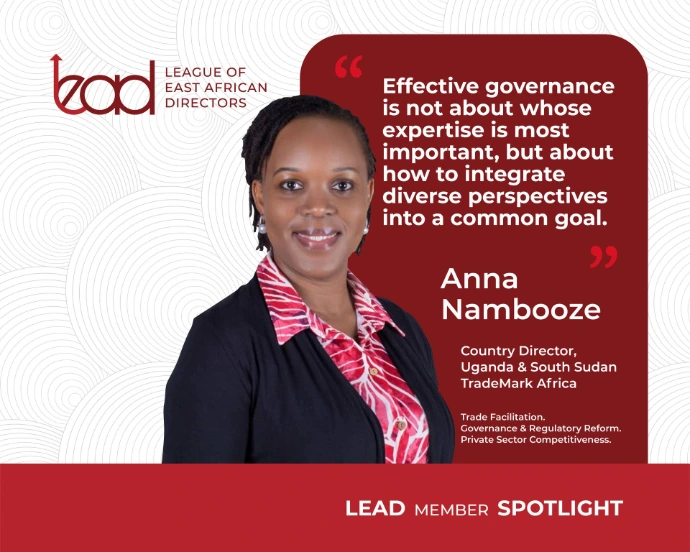
When Anna Nambooze took on two of TradeMark Africa’s more complex country portfolios during recovery from the Covid-19 pandemic, she inherited the kind of challenge that rarely appears neatly in strategy papers. Implementation timelines had tightened, budgets were under review, stakeholder expectations remained high, and confidence had to be rebuilt through delivery rather than reassurance.
Her response was characteristic of the leadership style she has developed over more than two decades in legal, regulatory and institutional reform. She brought the issues into the open, engaged partners candidly, aligned her team around what could realistically be achieved, and focused attention on interventions with the strongest prospect of impact to Uganda’s economy but more importantly, to individuals at the household’s level. The result was renewed confidence, successful delivery against revised priorities, and the continuation of partnership through a follow-on project that remains under implementation.
For Anna, the lesson was in leadership, some of the most defining moments are created by the ability to restore confidence when trust has been tested, align people during uncertainty, and move institutions forward under pressure. Her leadership is therefore anchored in transparency, discipline and the ability to hold difficult conversations without losing sight of delivery. As Country Director for Uganda and South Sudan at TradeMark Africa, Anna leads programmes that support more profitable trade across borders through stronger systems, improved infrastructure, policy reform, and institutional collaboration. Her work helps businesses, including SMEs and women traders, to access regional and international markets more effectively, while strengthening trade competitiveness across the region.
Her career has prepared her well for that task. Trained in law and shaped by experience across finance, ICT, governance and policy, she brings a rare ability to connect technical reform with institutional realities. She has contributed to governance frameworks, advised on multi-million-dollar programmes supported by governments and development partners, and reviewed more than fifty laws across ICT, trade and investment. That combination gives her a rare understanding of how rules, institutions and markets interact.
Anna’s leadership is not built on technical expertise alone. She has learned, across sectors, that lawyers, financiers, technologists and policy specialists often see the same problem from different vantage points. Effective leadership, in her view, lies in bringing those perspectives into a shared purpose, particularly where reform requires government, development partners and the private sector to move together.
That approach reflects values she traces back to her parents: integrity, discipline and respect for people. These principles continue to shape how she makes decisions, builds trust and leads across diverse institutional environments.
In today’s governance landscape, Anna believes that organisations often give careful attention to strategy, structures and targets, while underestimating culture. Yet culture determines whether people communicate honestly, take responsibility, collaborate across boundaries and respond well under pressure. For her, leadership is therefore not only about setting direction. It is about shaping how institutions behave when delivery becomes difficult.
Through the League of East African Directors, Anna values the opportunity to engage with leaders across sectors in conversations grounded in practical experience rather than theory. Her own contribution to that dialogue is clear: trust is built by openness, strengthened by accountability and sustained by delivery.